Lipizzaners and Luxury in Vienna
Guest author Lisa Pritchard, a Level II Centered Riding Instructor, recently visited the 17th International Centered Riding Symposium in Vienna. As part of the visit, she spent some time at the Spanish Riding School watching the world famous Lipizzaner horses go through their practice routines.
“It was a fabulous experience to watch these magnificent animals practicing their work. Each horse only works for 30 minutes at a time, but goodness, they work hard, and probably use as much energy as most horses that are hacked out for 3 or 4 hours. It is interesting, they are obviously warmed up a bit before coming into the school as they start work immediately and work without a break for the full half hour. At the end of the session the riders all line up, dismount and give the horses a sugar lump treat from a special pocket sewn into the tailcoats that the riders wear.

Morning practice. Photo copyright Sparre, Wikimedia Commons 2003
Anyway, we were soon gearing ourselves up for the main event, a private event (Privatissimum) at the Spanish Riding School, followed by a tour of the stables and then a buffet supper in the apartments there.
The Privatissimum was just fantastic. We got to see snippets of some of the training of the horse and rider, with a five minute lunge lesson for one of the eleves which the public normally never sees. The lunge horse used in the demo usually does Caprioles in his performances and when we clapped enthusiastically he thought he was on show. By goodness that eleve’s seat was good! The young horses were shown in their first stage forward work, and then we saw some of the later training with a more mature horse. Highlight of the Privatissimum was Chief Rider Andreas Hausberger giving his longlining performance with his 23 year old stallion Conversano Dagmar. This was truly a sight for sore eyes. Without any visible aids Herr Hausberger and Dagmar performed Piaffe, Passage, endless Tempi changes (he can do up to 50 at a time), half pass in canter, pirouettes, in fact the whole range of advanced dressage movements. A phenomenal demonstration of correct training and what can be achieved when horse and rider know each other so well. We applauded so hard our hands were sore.
When we got to tour the stables we saw Conversano Dagmar tucked up in his loosebox. He is TINY, must only be about 14.2hh, and looked nothing special at all, a little straw covered pony (he’d had a good old roll), yet in the performance you just couldn’t take your eyes from him as he has so much presence. The stables are wonderful as are all the stallions. Our guide was at great pains to let us know about the holidays that the horses have and was quite apologetic about their lack of turnout in Vienna, but honestly, there wasn’t an unsettled animal in the place. Every stallion was calm, relaxed and quite unfazed with their visitors. They only have bars between each stable so the stallions can nose each other and give each other a bit of a scratch and a more delightful group of animals you couldn’t wish to see.

A Lipizzaner stallion (Neapolitano Trompeta) being led out of the Spanish Riding School, Vienna. Behind: a rider in uniform. Photo copyright David Monniaux, Wikimedia Commons 2005
After the tour we trotted back into the apartments at the Spanish Riding school for our wine and buffet supper. The reason for the Brits’ sartorial efforts then became clear as Andreas Hausberger was waiting for our little group and spent the evening with us answering our many questions and giving us fantastic insights into the history of the Lipizzaner, the Spanish Riding School and the training of both horse and rider.
We’ve watched the best classical riding school in the world, listened to some of the best trainers in the world, eaten the best chocolate cake in the world and had fun in one of the best capital cities in the world. Team Austria – YOU ROCK!!”

A Lipizzaner made from cake at the Café Demel
Trying Le Trec
Le Trec, for anyone that doesn’t know, is probably the most fun you can have on a horse. Originally a French discipline developed as a test for tour guides, it involves three sections. It’s becoming increasingly popular in the UK, and the BHS run regular competitions nationwide. You can also complete at Kelly Marks’ Winter Series, which includes the PTV and COP sections only.
POR Phase
Much of the terminology in the sport is French. “POR” stands for Parcours d’Orientation et de Régularité, which roughly translates as ‘Test of Orienteering and Regular Paces’. This section involves orienteering over a set route at a set pace, navigating by an OS map and compass. This is designed to test accuracy and map-reading ability. Several stewards are positioned around the course to check that competitors maintain a regular speed between checkpoints.
COP Phase
In French, this section is known as ‘Maîtresse des Allures’, which translates to the UK equivalent Control of Paces. Competitors ride a marked corridor, riding out at as slow a canter as they can and back at as fast a walk as possible. This section is a test of the control and balance that you have as a partnership with your horse
PTV Phase
The PTV, or Parcours en Terrain Varié (test over varied ground) section involves navigating a series of obstacles, designed to simulate natural hazards that you might find out hacking, such as ditches and low-hanging branches.
Tryng It Out
Blue and I join a dozen other riders at Pam Rigby’s fantastic Chelford venue, New Barn Livery, for a tryout session with coaches Phil Weaver and Cath Cromarty from Mercia Trec. We’re split into smaller groups for safety, and I’m put into a group with five others. We have a varied bunch of horses: two hairy cobs, one warmblood dressage horse, an Andalucian, a Welsh cob and my TB/Welsh mare. The beauty of Trec is that any horse can take part, as the competition is so varied that every horse will shine at some part of it.

Julia McHugh demonstrates the lead corridor with Cathy London's horse Tuesday.
Trying POR
Due to space contraints at our venue, this stage is discussed as theory only. Phil provides us with a photocopied section of an OS map. In a Stage 1 (beginners) competition, we’d have 10 minutes to copy the route onto our own maps before setting off. Phil points out some of the ‘tricks’ that organisers can use to test competitors – having to leave the road to ride on a specific side of the hedge, for example.
Trying COP
The corridor is marked round the outside of the arena with plastic markers, with timing equipment set at both ends. Penalty points are awarded for leaving the corridor or breaking pace. Our group set off one by one with varying degrees of success – some horses don’t like going through the timing gates, and several change pace more than once along the corridor. Blue’s slow canter is not her strong point, but at least there’s no danger of her dropping down into trot and we don’t collect any penalties. Once through the gates at the other end, we return to the start of the corridor and walk back along it, aiming for a fast walk. Phil advises, “Try for a free walk on a long rein. The judge is looking for a relaxed, long-striding horse, not one that’s constantly nagging to break into trot.” Blue swings along happily on a long rein and collects a decent score. We all have several tries at the exercise until each horse can navigate the corridor without jumping or spooking at the plastic markers.
Trying PTV
Every competition includes up to 16 obstacles, which may be spread in the middle of a field. The obstacles are chosen from a master list and will vary slightly from venue to venue, as organisers make use of natural features such as hedges and ditches. Our indoor session consisted of a corridor, an S-bend, low-hanging branches, bending poles, a ditch to jump, a bridge and mounting and immobility exercises.
Fresh off the trailer, Blue is not happy about starting with the corridor, an exercise that requires precision. Two jump poles are laid a few inches apart, and the horse is required to walk, trot or canter between them without touching a pole. Needing to let off some steam, Blue tries to jump the poles lengthways before clattering down them sideways. I take her to the far end of the school to trot some series circles whilst Phil coaches the rest of the group.
The S-bend is made from jump poles on the ground and involves two tight turns on the forehand. “Ride your horse right into the first section until its forefeet are up against the pole, otherwise you won’t have room to get round,’ advises Phil. Here the smaller horses have an advantage, but we all manage a respectable attempt, although Blue is still feeling cross and jumpy. I take her off for a canter.
The low-hanging branches are next, a structure made from two sets of poles with light bamboo canes laid across the top. In a competition, the poles would only be a few inches about the height of the horse’s withers, so Phil coaches us to lie along our horses’ necks and off over one shoulder so that we don’t knock the poles down ourselves. All the horses are happy to walk under the structure the first time, but one or two get worried as poles are knocked down. Blue has settled now, and walks and trots under happily. Phil removes the first bar for the nervous horses, and soon has all of us walking under calmly.
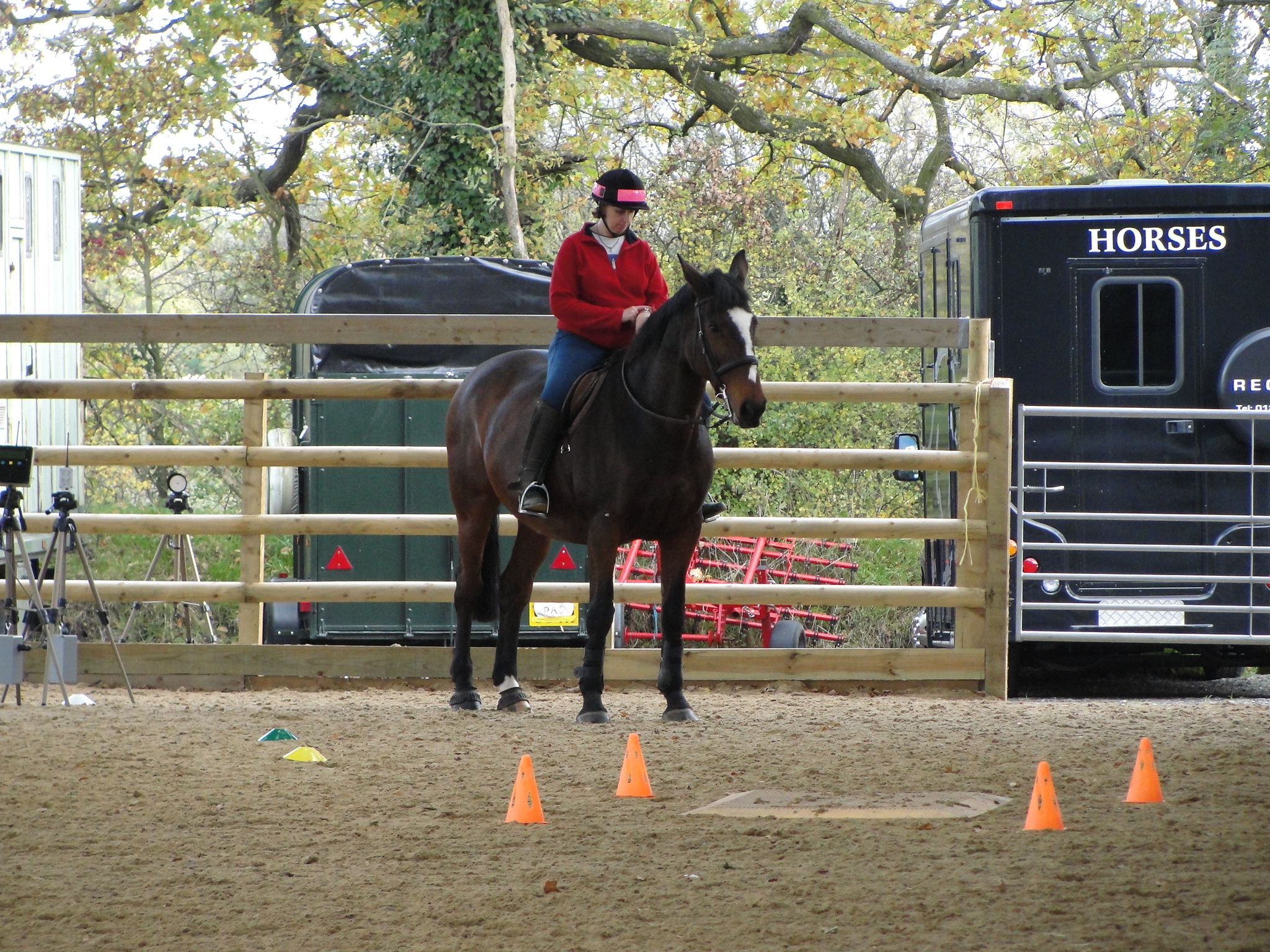
Julia waits to ride over the 'bridge'
Next to the immobility exercise. We all dismount, and one by one put our horses into the marked out ring. We secure our reins and leave the horses standing whilst we retreat to the outer edge of the circle. The horses need to stay inside the circle by themselves for a count of 10 to pick up maximum points. All the horses are tiring now, and the whole group manages this with no problem.
We’ve all enjoyed the day, and many of us are keen to try a real competition. Phil’s advice? ‘Practice. Many of the obstacles, such as corridors, bending posts and immobility areas can easily be reproduced at home. The more exposure your horse has, the more easily he’ll be able to cope with real obstacles.’
Five Reasons I Don’t Like Clipping
- The boiler suit. Oh yes, I look like a sex goddess when I’m clipping. Strong men weep.
- The hair. Picking bits of hair off the inside of shirt collars, the edges of contact lenses, off waistbands. For weeks. Despite the boiler suit.
- The clearing up afterwards. Hair sticks to a wet yard. I’ll still be finding it in August.
- Cleaning the clippers. De-furring the filter. Oiling the blades. Good thing it’s only a couple of times a year.
- Did I mention the hair?
And the top reason I do like clipping? The horses look great afterwards. For about five minutes. Until you have to do it all again.
Home Sweet Home
The weather is a sweltering 29 degrees as we set off with Dar, the club’s veteran horse, and Ocean, a tall dun horse with a nice attitude and willing stride. We leave the club field mid-morning, both horses already sweating.
An hour’s leisurely riding takes us across the stream, along the back lanes and through the first forest onto a well-defined track. The air is heavy with pine needles and wild thyme. Both horses swing along happily as we emerge onto the ridge and past a boggy watering-hole marked with the hoofprints of wild boar.
Crossing the road takes into the second forest where I get us …. erm…..slightly lost. Adopting a rough plan of ‘head downhill and hope for the best’ brings us out on the bottom road at the foot of the house. The horses are really hot now, and not impressed to be faced with the steepest hill of the journey. Dar begins to pant in a pointed manner, but eventually we emerge at the top of the hill next to the house.
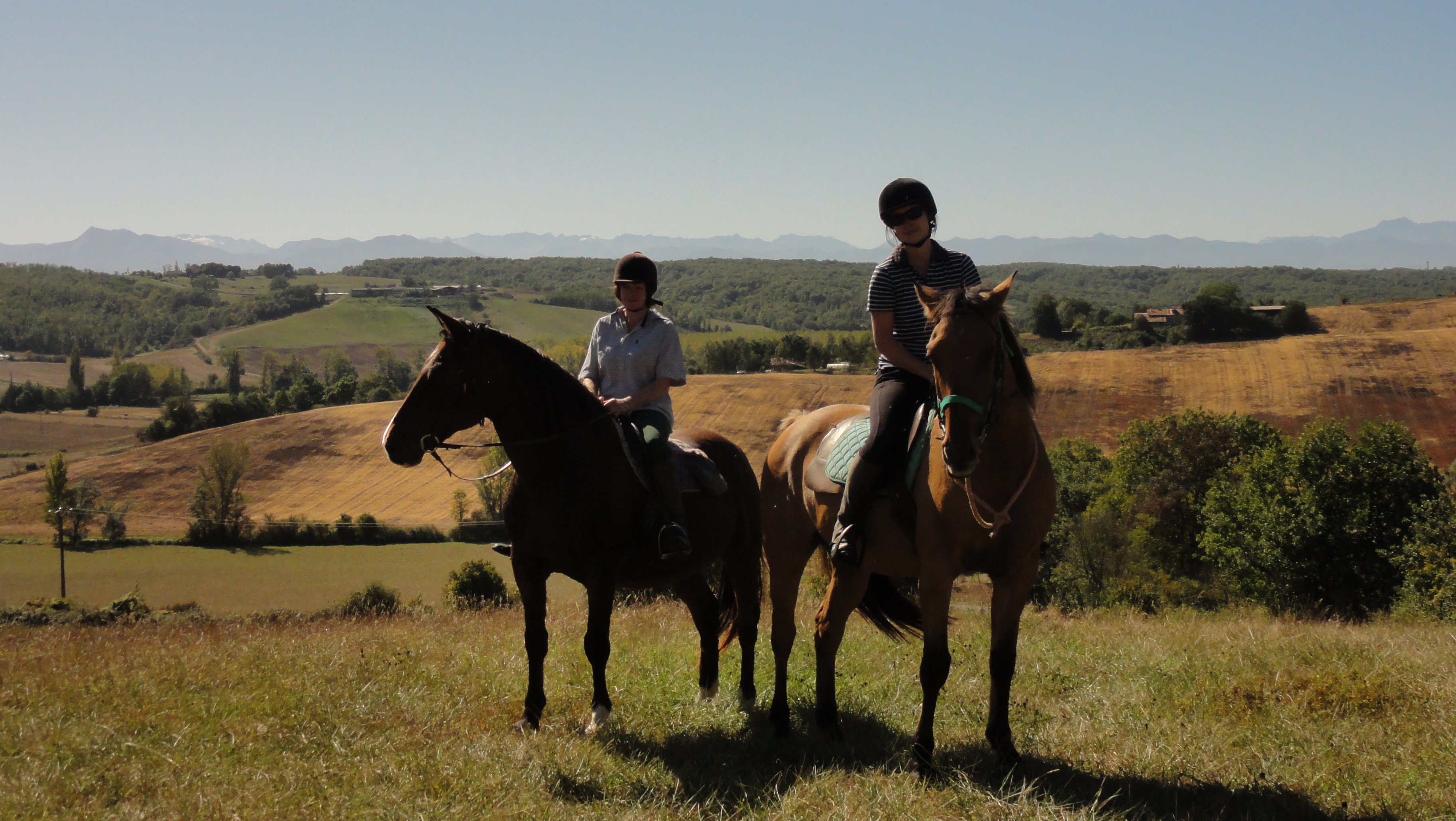
We make it to the top.
The horses are ecstatic to be unsaddled and allowed to roll. George hastily converts an old bin into a makeshift water bucket, whilst I race round the field tying up holes in the fence.

Hot and tired, the horses are desperate to be unsaddled.
Once hastily untacked, they roll….
…and roll….

….and roll.

We leave them to it and go off for some lunch. This turns into a fairly prolonged affair, partly as it’s too hot to think about riding back and partly due to the bottle of chilled rosé that George was organised enough to drop off earlier.
Eventually, we drain our glasses and collect the horses, who are less than pleased to see us.
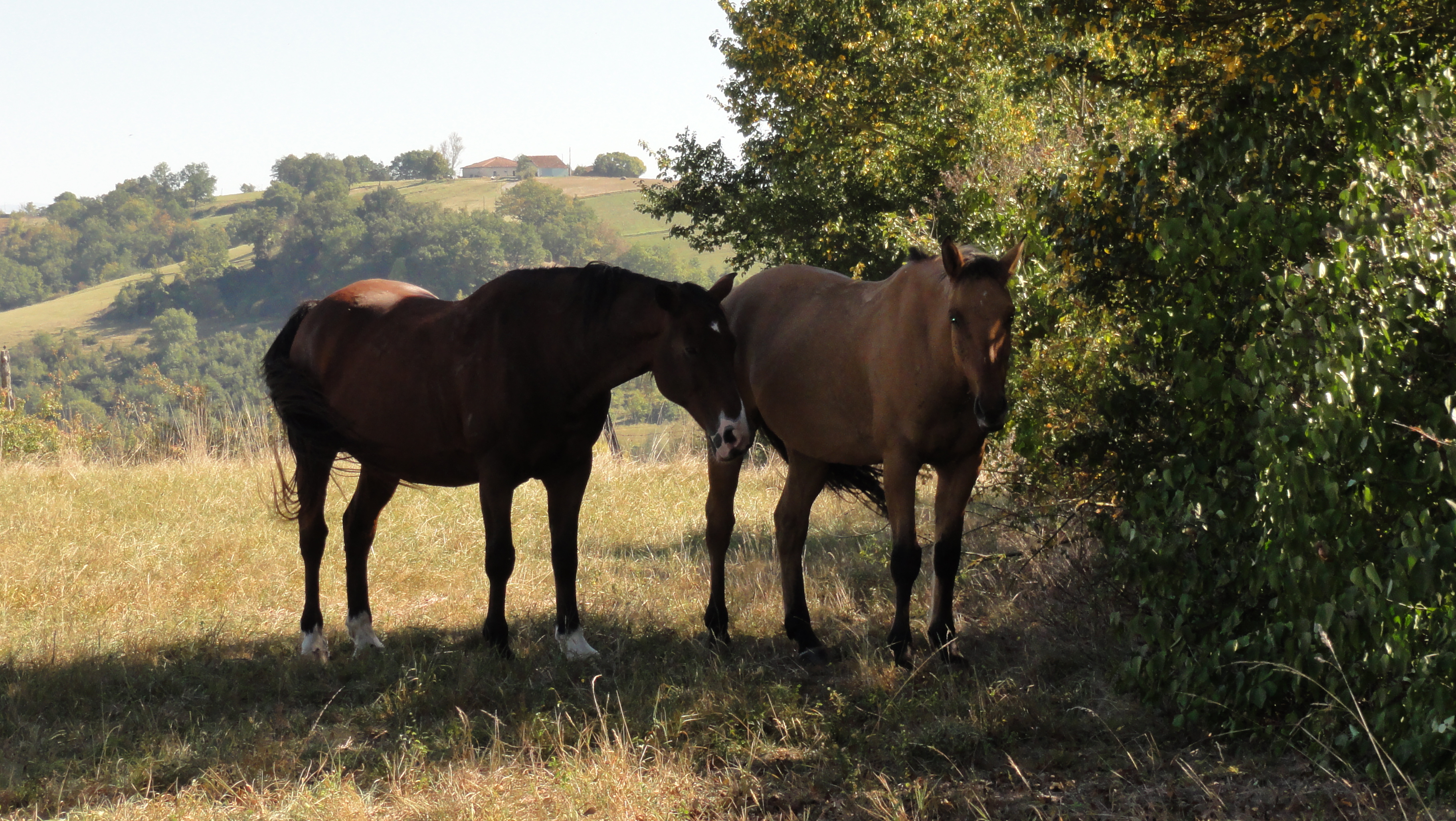
We're fine here, thanks. Ocean and Dar are not impressed.
We ride back out onto the hill just as the afternoon light starts to change and the mountains come into view behind the ridge.

Starting the return journey.
The ride back to the club is quicker, partly because we decide to stick more to the roads and partly because we leave out my ‘scenic detour’. We arrive back hot, tired but happy, ready to head back home to see if there’s any rosé left in the bottle.
Entente Cordiale
When we bought our old farmhouse in Gascony, my first concern wasn’t to find a roofer or a plumber – both of which were urgent – but a riding club. I was lucky to make contacts quickly, and joined the riding club in the local market town. Run on unusual lines, the club is “bénévole” – run by volunteers on a non-profit-making basis.
The club owns only one horse of its own, and the other eight or so are all owned privately. The owners lend them to the club, then every member pays a small monthly subscription. This fee covers the incidental costs such as insurance, horseshoes and winter feed. Every club member can then ride any horse at any time, although every effort is made to give owners precedence over their own horses.
The horses are strong, tough mountain ponies, suitable for riding over the rocky steep terrain round the Pyrenees mountains. Most are cross-breeds, a mixture of Selle Français and Quarter Horses. Often there’s some Appaloosa mixed in as well. The horses live out all year round, and are looked after on a rota basis by the club members.
The riding around the area is fantastic, with hundreds of kilometres of mountain paths to follow and spectacular views along the ridges. You can even ride to Spain over the mountains, barely touching a road.

The horses belonging to Jean-François at the club.
There’s no greater delight than taking one of these sure-footed ponies for a gallop along the mountain paths. I have to harden up and get used to the French tack though – my first few rides resulted in an unprecedented level of pain!

Galloping up the forest tracks.
Bend It, Stretch It
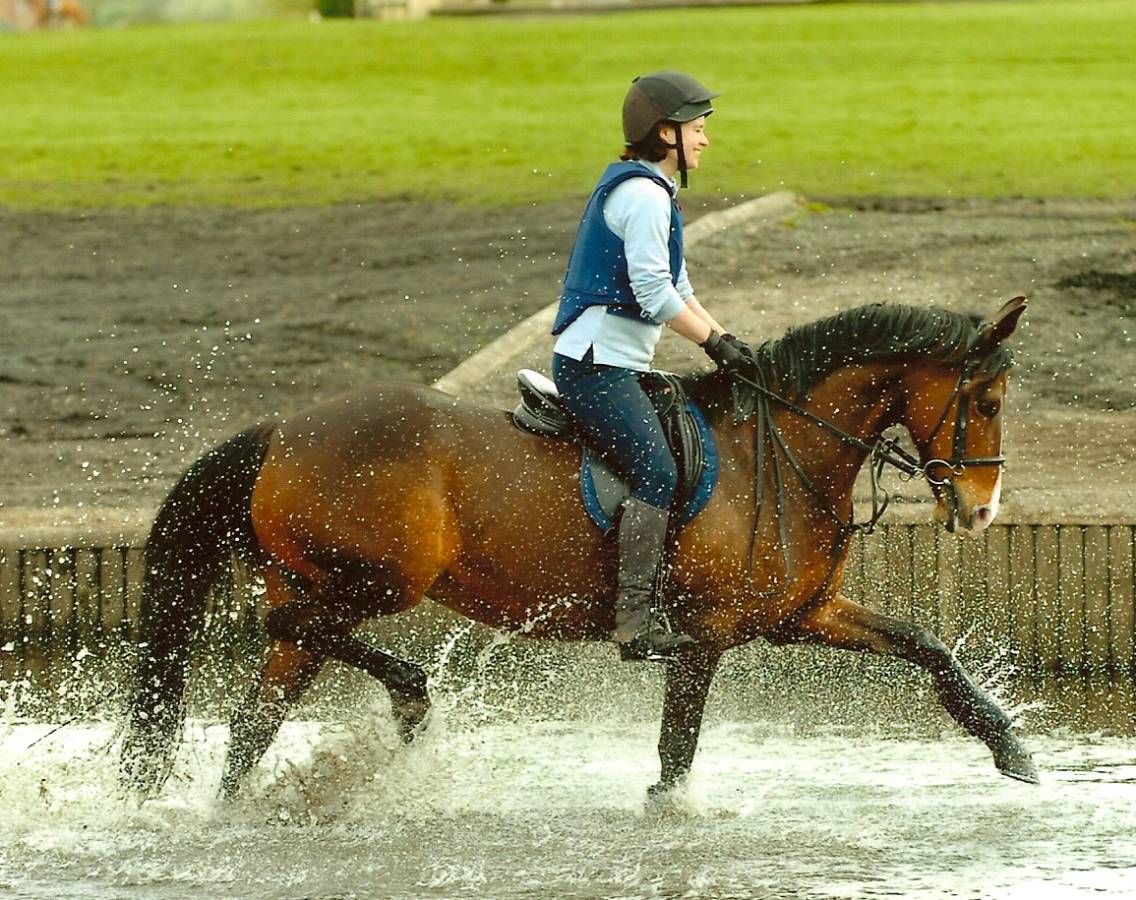
Anne the horse physio pays us a visit to see if she can get to the bottom of Blue’s back problems. To my surprise, my sensitive headshy pony is happy to let Anne manipulate and stretch her quite forcefully, and after a few minutes seems on the point of going to sleep.
Anne soon comes up with a diagnosis. The poorly-fitting saddle has stressed the long back muscles which have gone into spasm, and poor Blue now has hardly any lateral movement in her neck. Anne points out the bulge of muscle at the base of the poll where Blue has been setting her neck against the discomfort.
Anne massages and manipulates, and leaves me with a time for a follow-up visit and a set of exercises to be done faithfully twice a day. A further prescription is no ridden work for a fortnight, but as much in-hand and loose work as I can do.
Exercise 1 is the tail stretch, to free up the long back muscles and encourage Blue to tilt her pelvis upwards and tuck in her abdomen. Feeling very stupid, I ask a friend to hold Blue’s head whilst I stand directly behind her, hold the dock of her tail with both hands and gently lean my weight on it. After a few seconds Blue pulls back against me, which is the sign that one stretch has been completely correctly. I’m to do a set of three twice a day.
Exercise 2 is the carrot stretch, which I’m familiar with. However, it turns out that I’ve spent years performing it wrongly. Anne’s shown me how to slice the carrots lengthways to give maximum space for my fingers. With Blue’s head held loosely by my friend, I position the carrot so that my pony moves her head down, then encourage her to follow the carrot sideways until she’s looking backwards towards her own tail. I’m to repeat this three times on each side, twice a day.
The third and final exercise is the neck stretch, again to stretch her long back muscles. Holding the leadrope myself this time, I use a piece of carrot to bring her head down and low, until her mouth is a few inches from the ground and her neck stretched out to its fullest extent. Again, I need to do three repeats twice a day.
Anne points out that Blue will always be fighting against her conformation, as she has a natural tendency towards being ewenecked and weak-backed. However, these exercises will go a long way towards realigning the back muscles, and after she’s recovered I can do them once a week as a maintenance routine.
Looking Back
It’s been an interesting summer. Blue and I have both been suffering with back problems for much of the Spring, and only recently got back up to full health.
My sciatica was caused by – well, who knows. All I know is that it involved me lying on the floor for a month, unable to get up off the ground let alone on a horse. With a combination of physio, exercise and lots – lots! – of drugs, it eventually straightened itself out. As soon as I was able to ride, I found a standard riding position helped by relieving the pressure and keeping my weight in a comfortable place.
Blue’s problem was primarily my fault. She’d been telling me for weeks that there was something wrong – being reluctant to be caught, putting her ears back when being saddled, being sluggish to move off when I mounted. In retrospect, this was very unlike my bright, willing little pony, but I didn’t start to take real notice until she started spinning as a form of evasion, a brand-new habit for her.
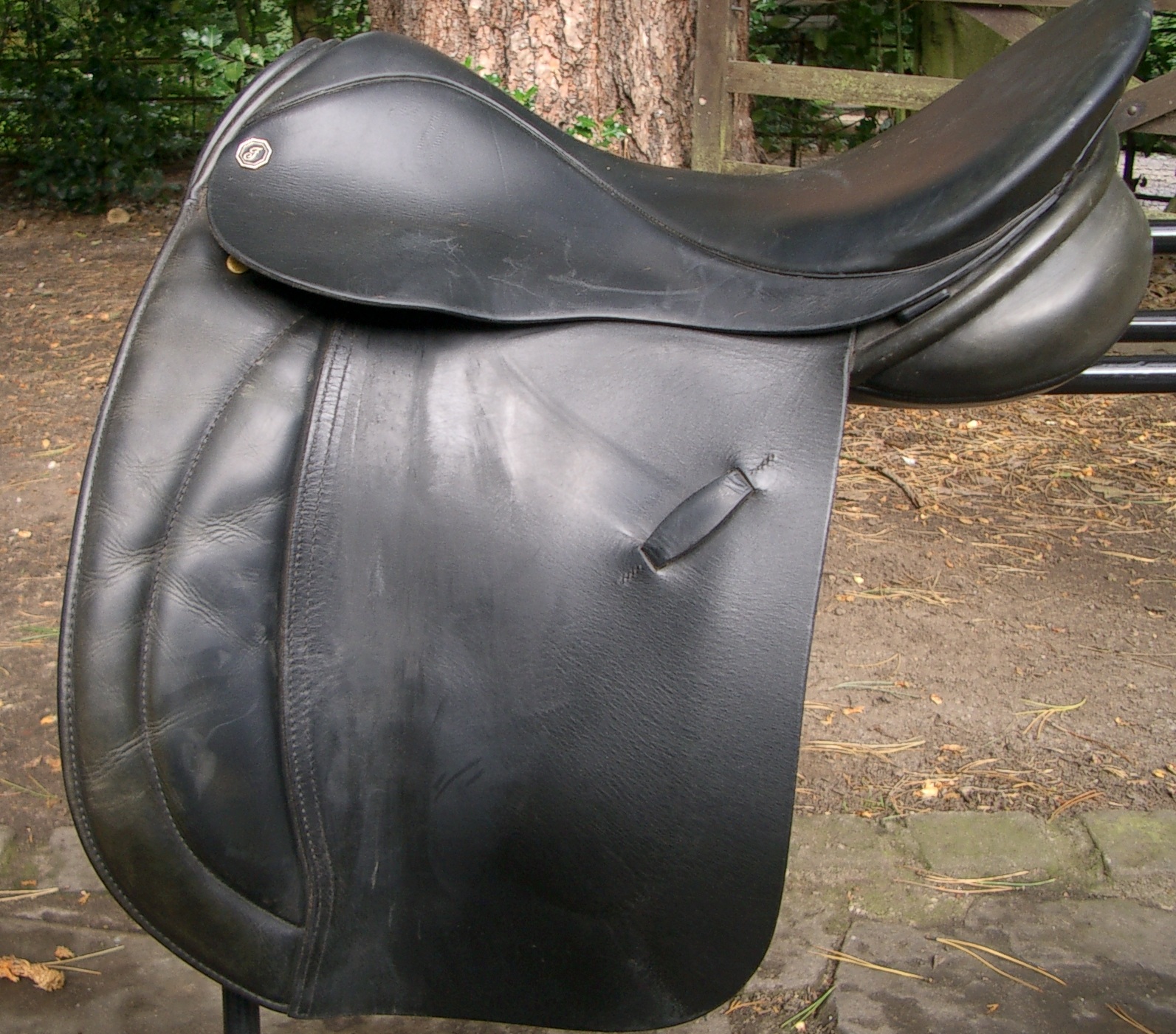
A visit from my saddler confirmed the problem. My saddle is a Farringdon, converted into a Flair before I bought it. Apparently the conversion had been oddly done, and the airbags at the front and back of the panels were different sizes. One of the back bags had slipped, causing the lining to ruck up and put uneven pressure on my mare’s back. The muscles had gone into spasm, and her back was tense and painful on one side. Sally the Saddler took the saddle away to correct the problem, then handed us over to Anne the Physio to embark on a long process of stretches and inhand exercise, which would take the whole of the first part of the summer.


 The Write Horse