Summer Camp 2012 – Bits and bitting talk
Summer camp 2012, held at Pam Rigby’s fantastic venue New Barn Livery, got off to a flying start this year. Although we’d all arrived armed to the teeth with waterproofs and rainsheets, we were soon discarding our coats for T-shirts and sun screen as the sun beat down.
The twelve riders were quickly divided into two groups, and Ride 1 went off to practice drill riding with Pam, while Ride 2 headed into the classroom for a session on ‘bits and bitting’, with Lisa Pritchard of The Modern Horse.

The ‘Ride 2’ riders. Left to right: Helen, Lisa, Catrina, Chrissie, Tracey and Liz. I was (wisely) behind the camera.
Lisa started off her talk by recommending Elwyn Hartley Edwards’ Complete Book of Bits and Bitting. “In my opinion, the definitive work on the subject,” she added.
“I believe that many commercial bits on the market today don’t really do anything,” she continued. “For example, bits fall into three broad categories – snaffle, Pelham and gag, the snaffle being designed to raise the horse’s head while the Pelham being designed to lower it. In order to be work efficiently, a gag bit should have fixed rings, as loose rings will cause the bit to slide under pressure rather than produce the required action.

A small selection from Lisa’s collection.
Always remember to take the conformation of your horse’s mouth into consideration when decided on a bit. Contrary to popular belief, a thick, vulcanite mouthpiece is not always a kind choice, as it’s not suitable for horses with fleshy tongues. The horse may appear to be working correctly as it’s foaming nicely at the mouth, but in fact the pressure of the bit on its tongue is causing it to over-salivate, as it can’t swallow its saliva properly. Very thick mouthpieces are more suitable for horses with thin bars or tongues, as they have more room in their mouths.
Another point to consider is the choice of metal for the bit. The stainless steel bits that currently dominate the market have many advantages – they’re strong, safe and easy to keep clean. However, they do have one big disadvantage, which is that they don’t allow the horse to salivate. Copper, nickel and sweet iron bits encourage a nice wet mouth, which is more comfortable for the horse, but as they’re softer metals they can wear to a sharp edge or even snap.”
Lisa then went on to look at individual bits.
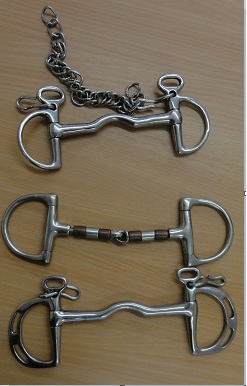
Cherry roller
This bit incorporates moving cylinders of copper with the stainless steel mouthpiece. It’s great for young horses, as it encourages them to mouth and play with the bit, and also helps prevent a horse with a tendency to boring from taking hold of the bit. Lisa’s cherry roller has D-rings, as the straight edges give extra support for a young horse. The long side bars of the Fulmer snaffle work in a similar way, giving a very clear ‘push’ signal whenever the rider uses the rein. This helps keep the horse straight.
Pelhams
The Pelham is a combination of the two bits of a double bridle, Bradoon and Weymouth. It shouldn’t be used with Pelham roundings, as these blur the action of the bit and make it less efficient. When used correctly with two reins, using the snaffle rein only will produce the same effect as a hanging cheek snaffle. Using the curb rein only simulates the action of a Dutch gag. The Pelham should always be used with a snug, correctly-fitted curb chain, with no more than one finger’s width between the chain and the horse’s jaw. Pelhams incorporating a jointed or French link mouthpiece are actually useless, as the bit becomes too flexible and loses its curb action. Jointed Pelhams have a snaffle action only.
Kimblewick/Spanish bit
Kimblewicks have a ported mouthpiece, curb chains and D-shaped rings, and are curb bits designed for use with one rein. They’re available with slots in the rings, and this type of bit mimics the action of a curb as the rein is moved from slot to slot. If used without a curb chain, this bit will have a snaffle action only.
Hackamore
The English hackamore is perhaps the best known form of bitless bridle, and consists of padded sheepskin noseband, a curb strap, and two long metal shanks. When the rider uses the reins, it produces an exaggerated level action, and puts pressure on the nose, jaw and poll. Some horses go very well in hackamores, but they can be very severe if used carelessly.
Myler bits
Myler are American bits. They have a thin, flexible mouthpiece with barrels rather than links which make the bit sit nicely in the horse’s mouth. with copper bands to encourage salivation, and come in many different variations. The Myler combination bit is a fairly mild bit, as it acts on the nose first then the mouth, giving the horse warning of a rider’s intentions.
“Don’t forget,” Lisa concluded, “that the most important aspect of any bit is the way it’s used. If the rider has heavy hands, the horse may not be comfortable in any bit. When choosing a bit for a particular horse, always look at the overall picture, and make sure that you understand the action of any bit that you use.”
The pony books I grew up with
I’m feeling nostalgic today, and the truly dreadful weather is keeping me well and truly indoors, in my book-lined office. Looking around the shelves of books, they’re a real mix, modern novels sitting shoulder-by-shoulder with classic literature.
Two short shelves hold my work books – copies of the Writer’s Handbook, a thesaurus and dictionaries. Four much longer shelves hold my horsy library – mostly reference books and autobiographies. A small section on the bottom shelf, however, is reserved for pony books.

When I was little, I owned dozens and dozens of the Pullein-Thompson sisters’ finest, along with piles of other books. Over the years, these have mostly been given away to friends with horsy children, but a few have escaped the cull. These are the books that have some special significance, or that I just didn’t want to get rid of. Many of these books were bought before I ever owned a real pony, and for a long time were the nearest I got. The copies are battered now, and I’m not sure I’ll ever read them again, but they’re a part of my horsy background.
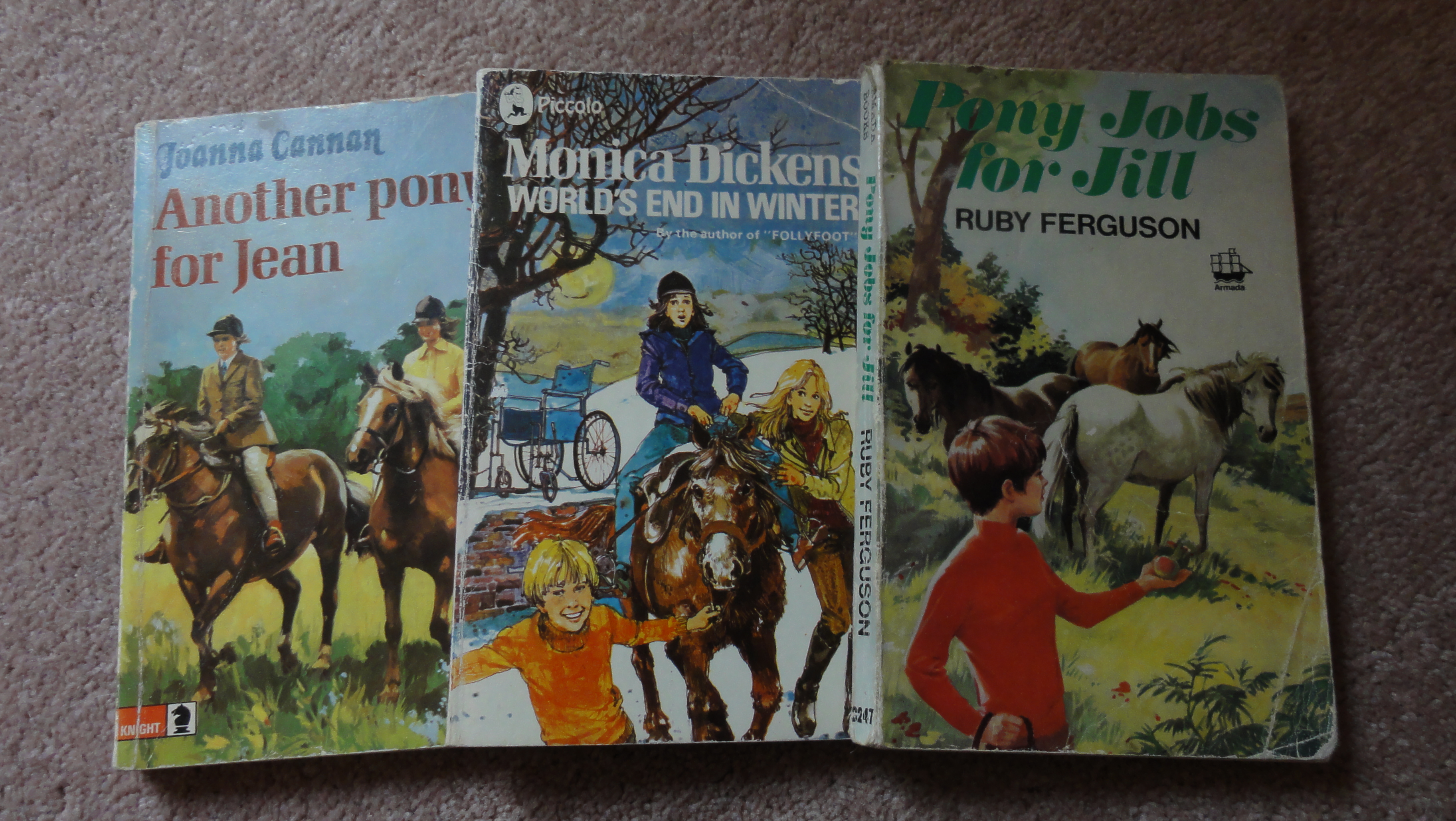
Still on the shelf:
The Jill books. Written by Ruby Ferguson (1899 – 1966), these are the chronicles of a 1950s pony-mad teenager and her friends. I have several first editions, but these are still in print and as popular as ever.
Patricia Leitch’s Jinny series. I loved these stories, about a girl who lived in a remote part of Scotland and had her own Arabian mare. In fact, I thought I was Jinny. I think part of the attraction was that they were being written to coincide with my childhood – the first book came out in 1976, and the last in 1988, which was pretty much the period that I was the right age to read them. These are also still in print.
Various Pullein-Thompson novels. The three sisters Josephine, Diana and Christine Pullein-Thompson are the doyennes of pony literature, and wrote dozens of books between the 1940s and the 1990s. Many of the books were one-offs, but some were a series, such as Christine’s Black Pony Inn books. Many of their books are still in print, but the early editions are worth seeking out if you can find them – they’re such nice-looking books.
Monica Dickens, 1915 – 1992, great-granddaughter of Charles. Monica wrote the World’s End series, about a family living in a former inn in the remote countryside. The books aren’t strictly pony books, more tales of a family who keeps ponies. These are sadly out of print, but it looks as though they might be available in electronic format shortly, which would help make them accessible to a new generation. Monica also wrote the Follyfoot series, about a horse rescue centre – great characterisation, and lots of nice little sub-stories.
Honorable mentions: KM Peyton’s Flambards series, Monica Edwards’ Punchbowl Farm books, and Joanna Cannan’s books. Joanna was the Pullein-Thompson sisters’ mother, and wrote the first real pony books. These are very hard to get of hold of now, so if you see one in a charity shop, grab it!
My favourite non-fiction book is a wonderful faded hardback called Riding Reflections by Piero Santini, published in 1933. It contains lovely observations on ‘The Geometry of the Forward Seat’, and the author notes that while he’s in favour of women adopting the rather daring astride position (as opposed to side-saddle), he does like them to look smart. This is illustrated with a line drawing of a lady with shingled hair, wearing a soft cloche hat and a long covert coat, as we all do when we go out for a quick hack these days.
I think part of the attraction of these books for me is their link to a specific time in my life, when when horses were even more important to me than they are now. I do know I’m not planning to get rid of my library any time soon.
PS. If you’re trying to track down a particular old favourite, Jane Badger, the UK’s only pony book specialist, might be able to help.
Getting the balance right
Over the years, my riding position has altered more times than skirt lengths. Partly this was due to fashion – for there are fashions in riding, just like anything else – and partly it was due to the horse I was riding at the time, and what I was doing.
When I got my first pony, Gyp, I’d been riding once a week at a riding school for years, and didn’t ride nearly as well as I thought I did. Gyp was a very well-bred Fell pony, and excelled at Mountain and Moorland showing classes, which quickly became my new passion. Show classes in the eighties required a slightly over-weight horse, and a rider who smiled manically at the judge all the time. Manic smiling made my cheeks hurt, but I quickly got the hang of ‘show riding’ – i.e. sitting up tall with my shoulders back – unfortunately, this made me arch my lower back and severely weakened my leg position. I’m now going to be very brave and show you a picture of me during this period – pretty awful, and that’s not mentioning the fact that I was clearly going through a goth period – well, it was 1985.

Gyp was a superstar, and a fantastic first pony, but was definitely on his own agenda. He was sluggish for 90% of the time, which led to me developing a riding position where my leg was on all the time, forcing my toes to turn out. The remaining 10% of the time, he liked to put a few lively bucks in. After coming off several times, I learnt to keep my knees in and my weight back. The overall effect by now on my position was very odd.
In the nineties, I was taken inhand by a series of excellent instructors, and they carefully picked my position to pieces and put it back together again. Things were better than before, but Gyp was gradually getting older, and could soon only cope with light hacking. My bombproof pony (he’d giving up the bucking by now) was so easy to ride that I soon started to slump, drop my hands and arch my back even more, as I was never actually called upon to do any real riding.
Fast forward to the present day (sorry, I just can’t put up any more photos of the early days, it’s too depressing), and I now have lessons with a fantastic Centered Riding instructor, Lisa Pritchard of The Modern Horse. My current horse, Blue, is as different from Gyp as it is possible to be. She’s sensitive and forward-going, and if I rode with my legs on permanently I’d end up in Scotland – but she does like me to keep my legs round her as it gives her confidence.
We all have an unconsious fault, and mine is that I still tend to tip my pelvis the wrong way, arching my lower back. To counteract this, I start each session by standing in my stirrups and kneeling down onto the saddle until my knees are firmly against the knee rolls. I then sit down slowly into the saddle, and push myself what feels like past the vertical, until the angle between my hips and my upper thigh is open and wide. This still feels strange, and will need up to two thousand repetitions before it feels natural, but as Blue’s back is weak it’s even more important that my balance is correct.
Here’s a more recent pic of me learning to play polo in France, earlier this year. Allowing for the fact that I’m rubbish at polo (no eye/hand co-ordination), and I’m concentrating very hard on something that isn’t the horse, you can see that my leg position is much stronger, with a level foot and no turning out of the toes.

Only another 999 repetitions to go, and it might start sinking in – there’s clearly hope for all of us.
Vive la difference
One of the nicest things about living partly in France is that I get to see different horse breeds, riding styles and cultures, that I wouldn’t normally come across.
For example, one of the local breeds near us is the Ane des Pyrenees, or Pyrenean donkey. This breed is distinctive-looking, with a pale muzzle and circles round the eye, contrasting with the black coat. They’re very common in the area, but I’d never come across them before I lived in France.
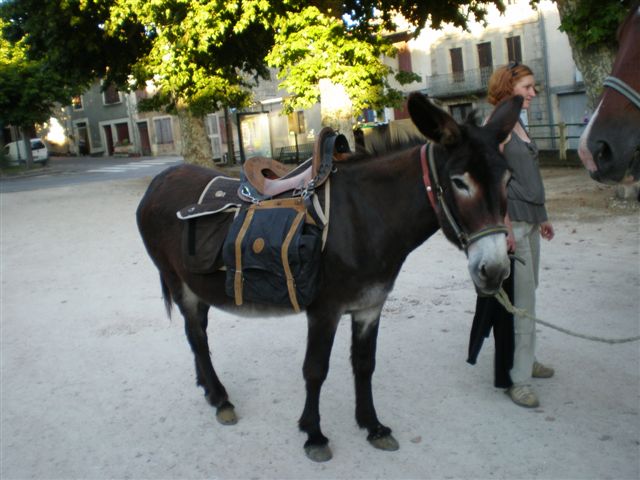
A black Pyrenean donkey carries supplies for the riding club’s Solstice celebration
Another local breed that I’ve discovered is the Merens. These tough little mountain ponies are the dead spit of English Fell ponies, and were bred for much the same qualities – strength, stamina and sure-footedness. I have a very soft spot for Fell ponies, having owned one for 23 years, and I’ve enjoying meeting the Merens and riding them through their native mountains. Riding a horse through its native environment is a special feeling – so far, I’ve ridden Fell ponies in the Lake District, a quarter horse in the US, Welsh ponies in Wales and Merens in the Pyrenees, among others – and it does help make you feel you’re on holiday.

Merens ponies from a trekking centre are ushered through the streets of Gavernie at the end of their working day.
II love to explore the different horsy cultures in foreign countries, and will often drag my long-suffering husband into tack shops when we’re abroad, so that I can examine the different types of bit and tack, and compare them to their English equivalent. I find American tack shops particularly interesting, as I have no idea what half the stuff does.
Modern cross-breeding now means that the native breeds of each country are not as widespread as they were. The horses at my French riding club are mostly quarter horses crossed with English thoroughbreds, with maybe a dash of the Selle Francaise, or French riding horse, thrown in. However, in France as much as in England, the traditional breeds are protected and encouraged, so hopefully ‘la difference’ will never die out, and I’ll be able to continue learning about the equine history of other countries.
Putting the fun back into your riding
Over the past couple of years, Blue and I have had a few ups and downs. We managed to sort out her back, my back and the saddle, and started on an intensive programme of schooling, designed to strength her muscles and help her re-balance. The results have been very satisfying, and she’s now a completely different shape to when we started. In fact, I was looking at her this morning as she chased that elusive last carrot round her feed bucket – a tubby, relaxed pony, dappled and shining with good health – and couldn’t believe she was the same horse we’d started with.
I’m getting such good results with the schooling that it’s tempting to forget that she sometimes needs to kick back and relax a bit. We hack a lot, but I’m using these times as impromptu schooling sessions, and often end up leg yielding back and forth across the road, if there’s no traffic. If I’m tempted to get too serious, I try and remember that it’s all about having fun, for both of us.
That’s why I’m looking forward to this year’s Summer Camp, organized by New Barn Riders. Last year’s camp – the inaugural event – saw 12 riders, on a range of very different horses and ponies, try a range of new activities. For two days, we played silly gymkhana games, organised quadrille rides and generally behaved as though we were still in Pony Club.
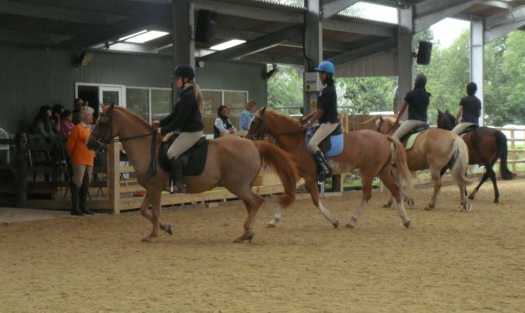
Practising the quadrille at Summer Camp 2011 – Blue and I are on the far right
Apart from anything else, I was amazed by how competitive everyone got over the games!

Stepping stones gymkhana game at Summer Camp 2011
The horses – which included a Fjord, several warmbloods, a retired games pony and a Welsh cob – loved the camp, without exception. Again, another surprise was how well some of the big competition dressage horses took to bending races and apple bobbing! Blue was in her element, being small, fast and quick on her toes – our team, of course, won.
The great advantage of gymkhana games – apart from the way they make you instantly regress to your childhood – is how easy they are to set up at home. Bending races can be practised with a row of traffic cones or bamboo stakes for markers; apple bobbing needs only a bucket of water and an apple. Many of the games need no equipment at all – but all are great for improving flexibility, reaction time and coordination.
This year’s camp is due to feature Western riding and agility demos. Our names are down already.
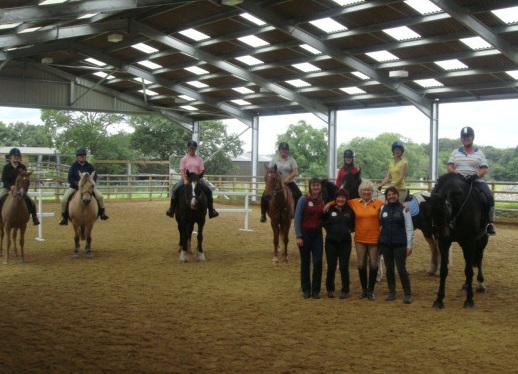
The organizers and some of the attendees at the 2011 event.
The joy of riding
I went for an evening ride last night – my first of the year, now that the days are longer. I only went out for an hour, but what a perfect ride. Blue behaved herself beautifully, and deigned to temporarily forget that she’s scared of leaves, rabbits, white lines and carrier bags. The hedges were so thick with creamy may flowers that it felt like riding between snow banks, and the air was heavy with the scent of honeysuckle and the droning of blissed-out bees. Every single driver I met slowed down for me, and most waved or smiled when I thanked them. It was such a relief to be riding in a T-shirt instead of being muffled up in winter coats, boots, sweaters and gloves, and to trot along verges that weren’t slick with mud.
Every year, as I spend the winter months picking ice off water troughs, trying to dry out sodden rugs and trying to find a brand of hand cream that soothes my raw, chapped fingers, I struggle to remember why I do it. But every so often, I have a perfect ride – and then I remember.

Now I remember – it’s supposed to be fun!
Bits and bitting – a touchy subject
If there’s one topic that seems to make riders foam at the mouth, never mind horses, it’s bits and bitting. I’m certainly no expert in bits or fitting them, but I’m constantly shocked by the approach that some people take to this.

A selection of snaffle bits, including cherry roller, loose ring and Fulmer.
I’ve seen dozens and dozens of riders who ride in certain bits and even recommend them to others, all without any idea of how the bit is designed to work, or what is actually happening when they use the reins. I’ve heard people say, ‘Oh, if you can’t stop him, it’s time to move up to a stronger bit. Try a Pelham/gag/Dr Bristol etc’. There’s a lovely old saying about this – unfortunately I can’t find the exact quote (just wasted lots of time looking for it when I should have been working), but it’s something like, “Out of every 100 bits, one is made for the inside of a horse’s mouth, and the others for the inside of a man’s mind.” Inappropriate bitting is never a good idea – your horse will be uncomfortable as a result, and probably much harder to stop. It’s well worth getting a bit properly fitted by an expert – it could save you a lot of frustration.
Types of bit
There are hundreds of different types of bit, but they can be grouped into three rough sections – snaffles, curbs and combination. Snaffles are the biggest and most common group, and include straight, jointed and mullen mouthpieces. The most commonly seen pure curb bit is the Weymouth bit, used as one of the bits on a double bridle. The third group – the combination – is becoming increasingly common, and includes Pelhams and Dutch gags. Personally, I’m not a huge fan of combination bits, which are designed to be a cross between a curb and a snaffle – I don’t think they do either job particularly well, and don’t allow you to be very subtle with aids.

The two bits of a double bridle – Bradoon (snaffle) top, and Weymouth (curb) bottom
Choosing a bit
Just like humans, horses are all individuals. Some horses have large, fleshy tongues, and hate a jointed bit as it digs in. Other have high roofs to their mouths, or sensitive lips, so one bit really doesn’t fit all. Snaffles are generally understood to be mild bits, but some horses will find them very uncomfortable. Remember that a jointed snaffle has a ‘nutcracker’ action, and if your horse has a particularly high head carriage, you could be exacerbating this by squeezing his head up every time you use the reins. In choosing a bit, you need to take into account the conformation of your horse’s mouth, his age, level of schooling and the type of work you want to do with him.
Problem horses
If you’re having problems with your horse’s brakes, or other behavioral issues, a stronger bit is unlikely to be a longterm solution – your horse will just get stronger and stronger in response, until you need to go up another level. Then what? Barbed wire? Razor blades? Instead, think about what’s causing the problem. Get your horse’s teeth and back checked to make sure that his issues aren’t pain related, then book a few sessions with a good instructor – chances are that if you improve your horse’s balance and co-ordination, he won’t need to lean on the bit anymore. If this doesn’t work, go back to basics – get back on the ground, try a milder bit, and teach your horse how to accept it using inhand techniques (ask an instructor to show you, if you’ve never done this before). Some horses never take to a bit at all, and are happier in a hackamore or bitless bridle.
Remember you should always try to use the mildest bit you possibly can, and then you always have the option of going up a level for special occasions such as cross country rides. With the huge selection of bits on the market, there’ll probably be one to suit your horse – but it’s worth putting some thought into choosing it.
__________________________________
By the way, if anyone’s interested, I use a Myler comfort snaffle on Blue. These are American bits (although they’re freely available in the UK), and I believe they were originally designed for neck-reining, as both sides of the bit move independently, unlike a traditional snaffle. It’s comfortable for Blue’s small, neat mouth, and I love the sensitivity it gives me. It’s been a hard slog, but this is definitely the bit that works for us. It’s not a cheap option – mine cost around £80 – but has been a great investment.
Horse riding gadgets – help or hindrance?
Like most other riders, I’ve explored numerous gadgets over the years – I used to be particularly partial to gadgets that I believed would turn my horse into a Grand Prix dressage champion, all with minimal imput from me. I’ve gradually come to realise that the only magical power most of these things possess is the power to empty my bank account – that isn’t to say that they don’t work at all, just that they don’t represent a short term fix.
Most gadgets tend to be designed to improve your horse’s balance and posture, and can be helpful to educate a young horse or inexperienced horse, or improve one that’s already working on the right lines. What they don’t do, in my opinion, is take a horse with a problem and turn it into a horse without a problem. Unless the horse’s problem is having an owner with too much money, of course.
Things I’ve used over the years include: martingales of various types, balance reins, market harboroughs, lunging aids, side reins, draw reins and a vast array of different bits. Some were helpful; others were borderline dangerous. What I’ve learned over the years is that nothing really beats old-fashioned groundwork, schooling and lateral exercises – and although some of the bits and pieces on the market will help you do a year’s job in six months, nothing will help you do it in six days if you’ve got an event deadline looming.
Unfortunately, it’s tempting to fall into the trap of using gadgets to try to control a strong horse or boost a rider’s fragile confidence. My personal bugbear here is martingales, as I know many, many people who just don’t use them correctly, and even some who seem to view them as a sort of fashion accessory.
The two types of martingale in common use – standing and running – both consist of a neckstrap and another strap that runs from the horse’s girth to either the reins or the noseband.

A running martingale attaches to the reins to prevent the horse lifting its head too high.
Both types are designed to make it harder for the horse to raise its head above a certain level, and therefore getting above the bit and becoming unbalanced, as an unbalanced horse is harder to control.

Standing martingales attach to a cavesson noseband, and are often worn by polo ponies for the duration of the match.
However, they are only designed to be used on a temporary basis, either to break a bad habit, whilst you are in the process of schooling your horse into a better outline, or in exceptional circumstances, such as hunting or jumping cross country. I occasionally use one if I’m going to be doing something unusual, but riders who use one longterm as part of their normal, everyday tack are not doing themselves or their horses any favours. Unbalanced horses quickly learn to balance on a martingale that’s constantly there to support them, and therefore don’t have to learn to carry themselves properly. Horses that are adopting a too-high head carriage as a result of pain – teeth problems or a bad back, for example – will find their escape method blocked by a martingale, and quickly exhibit other behaviour traits such as bucking or reluctance to work.
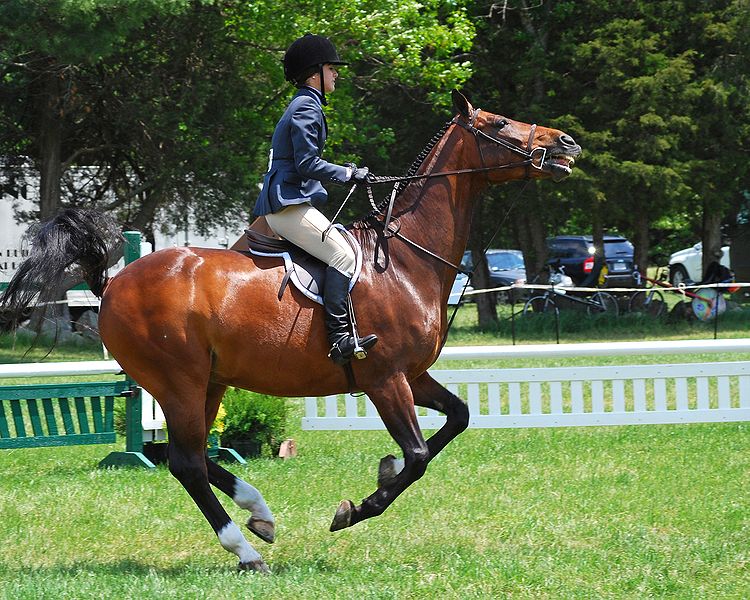
A standing martingale gives the rider on a strong horse a little extra control during an event.
Riders with poor confidence often like to use a martingale as they like the security of the neckstrap as an extra handhold. However, a neckstrap is really in the wrong place to provide a good handhold, as it’s too far up the neck and will tip the rider forwards – not what you want in an emergency! A better security device is a ‘balance strap’ – a thin strap such as a flash noseband or two spur straps, buckled through the D rings at the front of the saddle. This is in the correct position to be useful, and is thin enough to be held in the same hand as a rein if necessary.
The sign of a mature, well-schooled, relaxed horse is that it normally be ridden with the mimimum of equipment – a simple bit and bridle, and no gadgets whatsoever. Gadgets definitely have their place for education purposes, but should not be used as a substitute for correct work and riding. A note in one of my favourite horse books from the 1930s says, ‘Remember – martingales are always an admission of bad manners’ – and who’d want to say that about their horse?


 The Write Horse